
Before a single drop of RMC is poured into a foundation or structural column, quality control testing must take place. The most common, critical, and immediate field test performed on site is the Slump Test.
The Purpose of the Slump Test
The slump test measures the consistency and workability of a specific batch of fresh concrete. It tells the engineering team if the concrete mix is uniform, whether the water cement ratio is correct, and if the concrete will flow properly around dense steel reinforcement bars without forming voids.
How the Test Is Performed
The test follows a straightforward, standardized field procedure:
- A metal, cone shaped mold (known as a Slump Cone) is placed on a flat, non absorbent level surface.
- The technician fills the cone with fresh concrete from the truck in three equal layers. Each layer is tamped (“rodded”) 25 times using a standardized steel rod to ensure proper compaction.
- Once filled, the top surface of the concrete is struck off flat.
- The technician carefully lifts the metal cone vertically upward without disturbing the concrete pile.
- Without the support of the mold, the concrete pile will naturally subside or “slump” downward due to gravity.
- The technician places the upside down cone next to the slumped concrete, lays the tamping rod across the top of the cone, and measures the exact distance from the underside of the rod to the top center of the slumped concrete pile. This measurement (usually in millimeters) is the Slump Value.
Understanding Slump Profiles
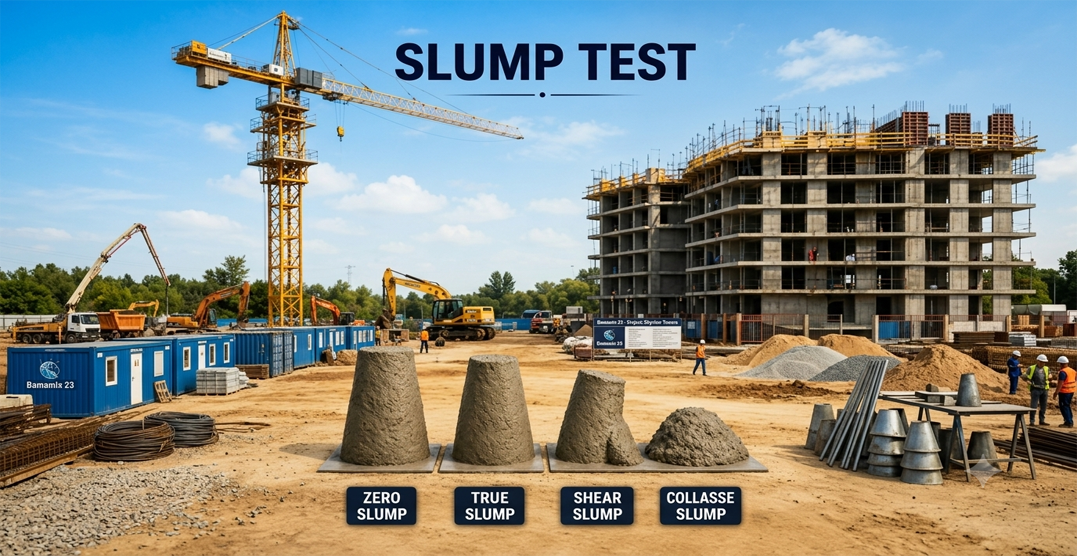
- True Slump: The concrete simply subsides smoothly, maintaining its overall shape. This indicates a well proportioned, cohesive mix.
- Shear Slump: The top half of the concrete breaks away and slides down sideways. This suggests a lack of cohesion, meaning the mix may be prone to segregation on site.
- Collapse Slump: The concrete completely breaks down, flattening out like a puddle. This is a clear indicator that the water cement ratio is far too high, or an excessive amount of plasticizer was added. A collapsed mix typically fails structural strength standards and should be rejected.
📍 Company Details
Address: Addis Ababa, Ethiopia
Subcity: Kirkos Sub City
Head Office: Kazanchis, Addis Ababa
Batching Plants: Bole Michael & Bole Bulbula
TIN Number: 0090355672
📞 Contact Information
Phone: 251 90 605 0505 / +251 90 880 5555
Email: bamamixplc@gmail.com